
Next month, the edtech start-up, that teaches coding to kids online, is launching operations in five new markets - the UK, Germany, Australia, New Zealand, and Singapore.

An insider said that over the past decade or so Cipla has become immune to the exits of leaders. There have been no directional change in the long-term strategies.

The acquisitions were made in areas which are closely related to Reliance's key businesses - telecom, internet, retail, digital, media, education, digital, chemicals and energy.

Its trajectory in telecom is well known but now it is pushing for a similar leap into the ranks of the top players in its other businesses: media and entertainment, e-commerce, a series of online businesses ranging from health to education, and retail.

The institute expects to complete both, phase-2 and 3 trials in India by the end of this year.

Fabiflu sales have grown by 62 per cent in July. It was launched in June. This drug is being used by doctors for mild-to-moderate Covid patients even if they are in home isolation.

The company said this was 'important' to reinforce the 'complete disassociation' from its erstwhile promoters -- Malvinder and Shivinder Singh.

Star earned ad revenues of around Rs 30 billion during last year's IPL. Whether it hits last year's figure will depend on how the economy picks up during the festival season.

While smart boys like the Ruias of Essar, Ajay Piramal, Max India promoter Analjit Singh laughed all the way to the bank, the Tatas, Anil Ambani, Malaysian tycoon T Ananda Krishna of Maxis (which invested in Aircel), Sistema, and Norway's Telenor burnt their fingers, notes Surajeet Das Gupta.

It has invested $2 billion and spent $200 million on its R&D centre in Bengaluru, the largest such centre outside China where some core technologies are under development.
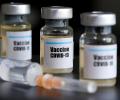
The procurement and distribution will be centralised though the government is yet to take a call on the initial number of doses that will be procured.
Growth has been under pressure since the lockdowns related to Covid-19 started and fresh prescription generations slowed.

Two of Apple Inc's global vendors -- Wistron and Foxconn (through Han Hoi), which already manufacture Apple phones in India -- and a third entity, Pegatron, which will be setting up a new plant, have applied to the government to be eligible under the PLI scheme for large-scale electronics manufacturers.

Serum Institute of India plans to make 300 million doses of AZD1222 by December, and will begin phase-2 trials soon. It has also tied up with Novavax for development and commercialisation of its candidate.

Serum Institute is investing $200 million to create capacities for the COVID-19 vaccine. Sohini Das profiles its 39-year-old CEO.
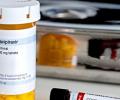
Favipiravir is the only oral anti-viral treatment approved in India for potential treatment of patients with mild to moderate Covid-19 disease.
Under these rules, telecom gear makers have to share their source codes and get their equipment tested by third-party labs accredited to the government.

India's telecom sector has been through dizzying peaks, troughs, policy U-turns, court battles, brutal competition, and daily controversies. India could go back to a private sector duopoly with just Reliance Jio and Bharti Airtel surviving the mayhem. The third player, Vodafone Idea, could be history.
Apart from favipiravir and remdesivir, its key Covid-19 products, DRL has already launched nutraceutical products and hand sanitisers during the pandemic.
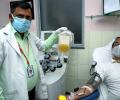
While the process of extracting plasma itself is simple, doctors say that it is the screening of donors, testing and filling up of numerous forms that takes time.
